
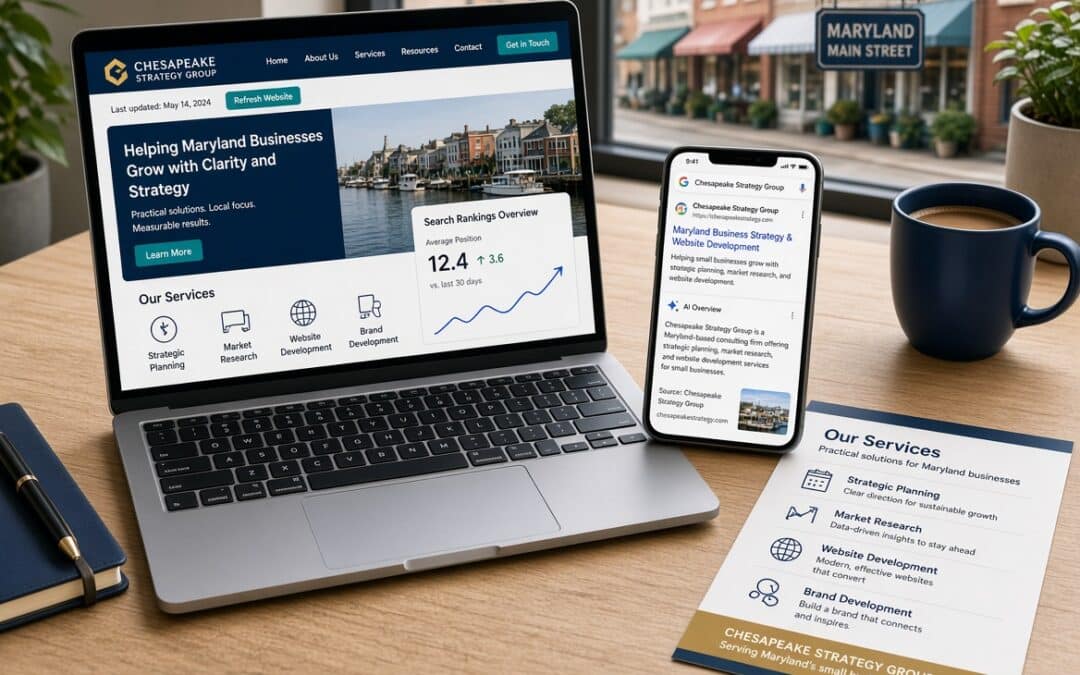
A website that looked “good enough” three years ago can still load. It can still show your phone number. It can still sit on page two of Google while a competitor with a simpler site, better answers, and more recent content takes the call.
That is the part a lot of small business owners miss. Updating a company website is not a vanity project. It is how you stay findable, trustworthy, and useful in a search world that now includes Google results and AI answers from tools like Google AI Overviews, ChatGPT, Gemini, and Perplexity.
At HD Marketing, we see the same pattern over and over with Maryland businesses and small companies nationwide: the site exists, but it has not been treated like a living asset. Hours are outdated. Services have changed. Blog posts from 2021 still sit on the homepage. Pages talk about the company instead of answering the questions customers type into search.
Search engines notice. Customers notice. AI systems notice even faster.
Your Website Is Not a Brochure. It Is Proof You Are Still in Business.
People do not browse websites the way they used to. They arrive with a question:
- “Who fixes this near me?”
- “How much does this service cost?”
- “Is this company legitimate?”
- “What’s the difference between option A and option B?”
- “Do they still offer Saturday appointments?”
If your site cannot answer those questions clearly, quickly, and accurately, two things happen. First, the visitor leaves. Second, search engines learn that your page did not satisfy the query.
Google has been explicit about this for years: its ranking systems are built to prioritize helpful, reliable, people-first content created for humans, not content created to game search. That standard is now baked into core ranking, not treated as a one-off “helpful content update.”
The practical meaning for a small business is simple. A page that was written once and never touched starts to look like a company that stopped paying attention. That is a trust problem before it is an SEO problem.
How Search Engines Reward Authority, Relevance, and Fresh Answers
Search is not just “add keywords and wait.” Modern ranking looks at whether your site is a good answer to a specific need.
1. Relevance: Does this page answer the question?
Google does not just match words. It tries to understand what the searcher wants and whether the page actually delivers it. Official guidance asks creators to check questions like:
- Was this written for people, or mainly to rank?
- Does the content fully answer what it promised?
- Will someone leave knowing enough to take the next step?
- Does it offer original information, experience, or analysis instead of a generic rewrite?
If a homeowner searches “emergency plumber Elkton,” they do not want a 2,000-word history of plumbing. They want hours, service area, what you handle, how fast you can arrive, and a way to call. Relevance is usefulness, not word count.
2. Authority: Why should anyone believe you?
Google uses a mix of signals tied to E-E-A-T: Experience, Expertise, Authoritativeness, and Trustworthiness. E-E-A-T is not a single score you can buy. It is a way of describing whether content looks like it comes from a real business that knows its work.
For a local company, authority looks like:
- Clear ownership and contact information
- Consistent name, address, and phone across the web
- Service pages written by people who actually do the work
- Reviews, case examples, photos, and specifics only an operator would know
- Content that matches what the business really offers today
A page that says “we are the leading provider of quality solutions” builds almost no authority. A page that says “we replace water heaters in Cecil County, typically same-day if you call before 2 p.m., and here’s what the visit includes” does.
3. Freshness: Is this still true?
Google has dedicated freshness systems. For some queries, older content is fine. For others, users expect current information: pricing ranges, regulations, product availability, local hours, seasonal services, new locations, and changing processes. Google calls this “query deserves freshness.” A search about a newly released movie should not surface production rumors from two years ago. The same logic applies when someone searches your industry for current options.
Important caveat: changing the “last updated” date without changing the substance is not a strategy. Recent core updates have been associated with penalties for fake freshness—new timestamps on old copy. Real updates mean new facts, clearer answers, better examples, and removed outdated claims.
That is why website maintenance is not the same as a redesign. You can keep the same brand and still need regular content and information updates.
Stale Websites Lose Twice: In Google and in AI Search
This is the shift many small businesses have not fully absorbed.
People still Google. They also ask AI tools. Those systems do not invent a trustworthy local business out of thin air. They retrieve, summarize, and cite pages that look current, specific, and easy to extract answers from.
Google’s own guidance on generative AI features in Search is blunt: SEO still matters because AI Overviews and similar features are grounded in the same Search index and ranking systems. The long-term advantage still comes from unique, useful content—not tricks.
Independent analyses in 2026 keep pointing the same direction:
- AI-cited pages tend to be fresher than classic organic results.
- Pages updated within the last year show up far more often in AI citations than pages left untouched for several years.
- Clear, self-contained answers near the top of a page are easier for AI systems to quote than vague marketing copy spread across five sections.
If your competitor’s site says, in plain language, what they charge, who they serve, and how the process works—and yours still says “contact us for more information”—the AI answer will often mention them, not you.
That is not science fiction. It is the new storefront window.
What “Updating Your Website” Actually Means
Updating is more than a new homepage banner. For most small businesses, the highest-return work falls into five buckets.
1. Update the facts customers use to decide
Audit every page for:
- Hours, phone numbers, addresses, and service areas
- Services you no longer offer
- Services you added but never documented
- Staff, credentials, insurance, licenses
- Pricing ranges or “starting at” language if you publish them
- Seasonal offers, financing, warranties, and turnaround times
Wrong facts do not just confuse people. They create support calls, bad reviews, and search distrust.
2. Rewrite pages so they answer questions, not just describe the company
Most older small-business sites are built around “About Us” thinking:
- Who we are
- What we offer
- Why choose us
Better pages are built around customer questions:
- What problem do you solve?
- Who is this for?
- How does the process work?
- What should someone expect to pay or prepare?
- What happens after they call?
- Why is this different from the next option in town?
A strong service page often includes an FAQ section that uses the exact language customers search. That is not keyword stuffing. That is meeting intent.
3. Refresh old content instead of only publishing new posts
New blog posts help. Updating existing pages often helps more.
A three-year-old article that already ranks for a useful question can outperform a brand-new post if you:
- Add current examples
- Tighten the answer in the first screen
- Remove outdated advice
- Add internal links to newer service pages
- Include original details from real jobs, not generic AI filler
Search engines and AI systems both look for living knowledge: evidence that the information has been checked against the present.
4. Strengthen topical authority, not random posting
One post about “10 social media tips” and one post about “holiday hours” will not make a HVAC company look authoritative. A cluster will:
- Emergency repair
- Maintenance plans
- When to replace vs. repair
- What a visit costs
- How to prepare the home
- Common problems in older Maryland houses
- Financing and seasonal demand
That is how a small site starts to look like the local expert instead of a placeholder.
5. Keep the technical foundation from quietly rotting
Content is the headline. Technical decay is the silent killer:
- Slow mobile pages
- Broken forms
- Mixed HTTP/HTTPS issues
- Outdated plugins
- Missing backups
- Pages Google cannot index cleanly
- Core Web Vitals that make the site feel sluggish
A brilliant article on a broken, slow, insecure site still underperforms. This is why website hosting, security, backups, and maintenance belong in the same conversation as SEO.
The AI Component: How Small Businesses Can Compete Without a Newsroom
There is an AI story here, and it is not “let a chatbot write your entire website.”
The businesses that benefit from AI are the ones that use it as a production advantage while keeping human expertise in charge.
Research on content teams has found that marketers using AI publish substantially more content, but the overwhelming majority still edit and review it. Pure unreviewed AI copy is rare among serious operators for a reason: search systems and customers both punish generic, ungrounded writing.
For a small business, the useful AI workflow looks like this:
Use AI to go faster
- Turn a list of customer questions into a content outline
- Summarize review themes so you know what people actually ask
- Draft a first pass of an FAQ
- Compare your page against competitor topics you have not covered
- Suggest internal links and missing sections
Do not use AI as the expert
- Do not invent pricing, licenses, or guarantees
- Do not publish advice you would not stand behind on a job site
- Do not mass-produce 30 nearly identical posts
- Do not skip local specifics only you know
Google’s people-first guidance still asks whether content was created primarily for humans and whether it reflects real experience. Scaled automation without expertise is exactly the pattern that got sites demoted in earlier helpful-content crackdowns, and those quality standards did not disappear when the named update was folded into core ranking.
The winning small-business model in 2026 is:
- Owner or technician supplies the truth.
- AI helps organize and draft.
- A human editor makes it accurate, local, and specific.
- The page gets updated when the business changes.
That combination is how a 5-person company can publish with the consistency of a much larger team.
AI search adds one more requirement: write in extractable answers. Lead with the conclusion. Use plain language. Include a concrete detail—service area, timeframe, process step, or definition—close to the question. AI systems prefer passages they can lift without guessing.
What Happens When You Do Not Update
The cost is rarely dramatic on day one. It is cumulative.
- Your Google Business Profile says one thing. Your website says another.
- A competitor answers “how much” and “how long.” You answer “we care about quality.”
- Old blog posts attract the wrong traffic and convert nobody.
- AI tools summarize your industry using other companies’ pages.
- You keep paying for a website that no longer works as a salesperson.
Meanwhile, the businesses that treat the site like an operating system—not a one-time project—keep collecting the searches you used to win.
A Practical 30-Day Website Update Plan for Small Businesses
You do not need a six-month redesign to start. Use this sequence.
Week 1: Fix trust and accuracy
- Verify NAP (name, address, phone) on every key page
- Update hours, service area, and current services
- Test contact forms, click-to-call, and mobile layout
- Add or refresh photos from real work, not stock only
Week 2: Fix the money pages
- Homepage
- Top 3 service pages
- About page
- Contact page
For each one, add a clear answer to: who it is for, what you do, what happens next, and why someone should choose you.
Week 3: Build a question bank
Pull questions from:
- Sales calls
- Google reviews
- “People also ask” results
- Front-desk conversations
- Common objections
Turn the best 10 into FAQs or short articles. Answer them in the first paragraph, then expand.
Week 4: Refresh one old winner and publish one new useful page
Do not guess. Look at Search Console or your analytics. Update the page that already gets impressions. Then publish one new page that fills a gap your customers keep asking about.
Then repeat quarterly. Freshness is a habit, not an event.
How This Ties Back to Getting Found Locally
For local service businesses, website updates and local SEO work together. Search engines want consistency between your site, your listings, and the real-world business. Content that names the communities you serve, explains local constraints, and stays current helps both classic local pack results and AI answers that recommend “a company near you.”
That is also why directory listings, reviews, and on-site content should not live in separate silos. A great review that mentions a specific job in Charlestown or Elkton is marketing data. It should inform the next service page update.
The Bottom Line
Search engines reward websites that behave like reliable experts: they stay current, they answer the question the visitor actually asked, and they demonstrate that a real business stands behind the words.
AI does not replace that. It raises the stakes. The businesses that win will be the ones whose websites are easy for people and machines to trust.
If your site was built once and then left alone, you do not necessarily need a new brand. You need the digital equivalent of unlocking the door, turning on the lights, and putting today’s prices and services in the window.
Ready to Make Your Website Work Harder?
HD Marketing helps small and mid-sized businesses keep their websites accurate, search-visible, and useful—without long-term contracts. That includes website design, ongoing WordPress care, Local SEO, and SEO Plus content built around the questions your customers are already asking.
If you want a straightforward look at what is outdated on your site and what would actually move the needle, start here: hdmarketingonline.com. Call 888-846-7426 or reach out through the site. No contract. Cancel anytime. The website should be doing the heavy lifting so you do not have to.

Recent Comments